Orbital Stability of Closely-Spaced Four-planet Systems
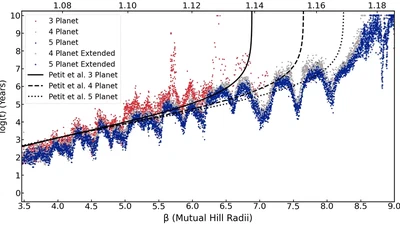
Four-planet system stability falls between three- and five-planet systems and is primarily driven by first- and second-order mean motion resonances, with a stability phase-shifting …

My research is in nonlinear dynamical systems and the control of agents within such systems. The problems I find most compelling sit at the boundary of what is mathematically tractable and what is physically meaningful — trajectory optimization under chaotic dynamics, autonomous proximity operations where interacting boundary layers or gravitational flows make classical methods fragile, and multi-agent systems that must act safely under uncertainty.
Concretely, this means work in stochastic trajectory optimization, differential game theory for spacecraft pursuit-evasion and cooperative maneuvering, nonlinear system identification, and computational astrodynamics. Application domains include cislunar space operations, very low Earth orbit (VLEO) satellite maintenance, and — from earlier work — the long-term stability of compact planetary systems.
Four-planet system stability falls between three- and five-planet systems and is primarily driven by first- and second-order mean motion resonances, with a stability phase-shifting …
Differential games formalize multi-agent problems where each agent optimizes a continuous-time objective subject to shared dynamics and the decisions of others. In the spacecraft context this captures pursuit-evasion scenarios, contested proximity operations, and cooperative rendezvous where the objectives of different agents are in tension.
My PhD work develops theory and algorithms for these settings — focusing on tractable solution methods that scale to the dynamics and constraints encountered in cislunar and low-Earth-orbit environments.